Top Word Count Mistakes to Avoid in Academic Writing
Published on: October 12, 2025 | Author: Online Word Counter Free Team
Table of Contents
Introduction: Why Perfect Writing Matters Academic writing is more than just an assignment; it's a core part of your identity as a scholar. However, it's a complex skill where even experienced academics struggle. Research shows that a significant number of academicians face cognitive difficulties in writing and are hindered by fear of rejection and perfectionism. In fact, one study found that 85% of surveyed university students reported anxiety about losing originality in their work. This guide is designed to walk you through the most common mistakes to avoid in academic writing and common errors in academic writing, serving as a strategic map to help you produce more persuasive, professional, and higher-scoring work. We will explore various types of errors in academic writing, from common grammatical mistakes and grammatical errors to academic writing errors in structure and style. You will learn about words to avoid in academic writing, common writing mistakes like vagueness and wordiness, and what not to do in academic writing, including things to avoid like plagiarism and informality. This resource also provides writing errors examples and addresses mistakes to avoid when writing a research paper, helping you to understand what should you avoid in academic writing to enhance your credibility and clarity.
Data and Statistics: The Reality of Academic Writing Errors While hard statistics on the frequency of specific grammatical errors are scarce, surveys into student attitudes highlight deep-seated concerns that are directly related to the foundational mistakes discussed in this guide. A 2023 study by the Academic Writing Institute found that among 1,200 surveyed university students:
- 85% reported anxiety about losing originality in their work
- 75% were concerned about a lack of critical thinking in their drafts
- 70% feared becoming overly dependent on technology like AI writing tools
These findings underscore that common writing errors are often symptoms of broader challenges in the research and writing process. The emphasis on originality and critical thinking highlights the importance of thorough research and original thought to avoid superficial analysis, while the concern about technology dependence points to the need for tools that aid, rather than replace, the writer's own voice and analytical skills.
Part 1: Foundational & Structural Errors
These are high-level mistakes that can undermine your entire paper.
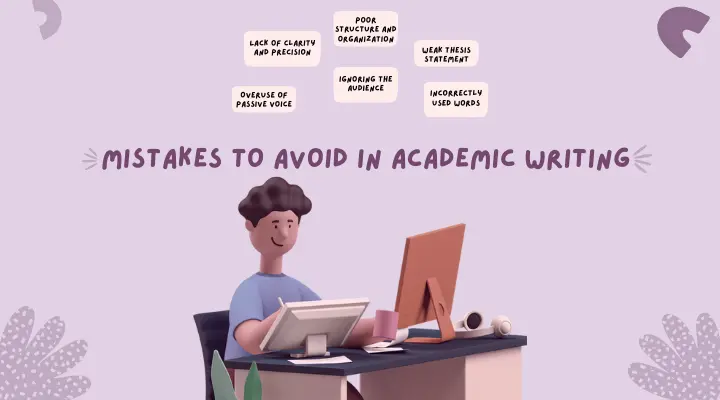
Lack of Clarity and Precision
The Problem Using vague language or overly complex sentences that confuse the reader. Academic writing should be a model of clear communication.
The Fix Aim for straightforward language. Use precise terminology. For example, instead of "a lot of people", write "a significant proportion of the population (e.g., 72%)."
Poor Structure and Organization
The Problem A disorganized paper is difficult to follow. Readers should never feel lost in your argument.
The Fix Always use a clear structure: Introduction, Body, and Conclusion. Within the body, each paragraph should present one main idea, signaled by a strong topic sentence.
Inadequate Evidence and Support
The Problem Claims made without credible evidence weaken your argument. Relying on anecdotal evidence or personal opinion is a common critical flaw.
The Fix Support every significant claim with data, citations from scholarly sources, or logical reasoning.
Overuse of Passive Voice
The Problem While sometimes necessary, excessive passive voice can make writing less engaging and more wordy (e.g., "The experiment was conducted by the researchers.").
The Fix Strive for the active voice where possible (e.g., "The researchers conducted the experiment."). This makes your writing more direct and dynamic.
Ignoring the Audience
The Problem Not tailoring your tone, complexity, and explanations to your expected readership (e.g., your professor, a specialized journal).
The Fix Consider what your audience already knows and what they need you to explain. This determines the level of jargon you can use and the background information you must provide.
Inconsistent Style and Tone
The Problem Switching between formal and informal language confuses readers about your intent and professionalism.
The Fix Maintain a consistent, formal academic style throughout your paper. Avoid slang, contractions, and casual phrasing.
Neglecting Revision and Proofreading
The Problem Submitting a first draft guarantees that errors in grammar, punctuation, and coherence will remain. Editing is where good writing truly happens.
The Practical Fix Adopt a three-pass editing system: first for content and structure, second for sentence-level clarity, and third for grammar and spelling.
Inadequate Attention to Formatting
The Problem Ignoring the specific formatting and citation style (APA, MLA, Chicago) required by your assignment leads to an immediate loss of credibility.
The Fix Always double-check the style guide and format your references and in-text citations meticulously before submission.
Part 2: Ethical & Formal Errors
These mistakes can have the most serious consequences for your academic standing.
Plagiarism
The Problem Presenting someone else's ideas, data, or phrasing as your own without proper attribution is the most serious academic writing error, with consequences ranging from failing grades to expulsion.
The Fix You must cite every source you use, use the correct referencing system, and place all quoted text in quotation marks.
Incorrect Citations
The Problem Even unintentional citation errors, like inconsistent formatting or missing publication details, undermine your credibility and signal carelessness.
The Fix Always use a consistent, required citation style and double-check every entry against an official guide.
Too Informal
The Problem Academic writing requires a formal tone. Using informal language makes your work seem unprofessional and less authoritative.
The Fix Use the following table to upgrade your word choice:
| Informal Word(s) | Formal Replacement(s) | Example |
|---|---|---|
| America | the United States, the US, the USA | The study focused on the United States. |
| bad, good | poor, negative / optimal, strong, prime | The results were poor. The findings were strong. |
| get, got | receive, obtain | The writer obtained a prize for her work. |
| kind of, sort of | somewhat, to some degree | The scholar somewhat agreed. |
| show | demonstrate, reveal, illustrate | The interviews revealed a shared concern. |
Pitfalls of Formal Writing: What to Avoid
Moving beyond informal language, several other pitfalls can compromise the formality and objectivity of your work. A key principle is to avoid subjective bias and unsupported generalizations. This means eliminating personal opinions that are not backed by evidence and avoiding vague language that lacks precision. Furthermore, an overreliance on the passive voice can make writing feel indirect and cumbersome. Finally, ignoring specific formatting guidelines (like APA or MLA) for citations, margins, and headings presents an unprofessional appearance and can lead to accusations of negligence.
Words to Banish from Formal Writing
To achieve a truly formal and academic tone, certain categories of words should be consistently avoided. The table below expands on the informal words mentioned earlier to include other problematic types:
| Category | Words to Avoid | Formal Alternatives / Notes |
|---|---|---|
| Informal Verbs | get, got, say, think | obtain, receive, state, argue, postulate |
| Vague Nouns | stuff, thing, a lot | elements, factors, components, a significant number |
| Slang & Clichés | cool, guys, at the end of the day | effective, participants, ultimately, in conclusion |
| Fillers & Emphatics | really, very, extremely, so | (Often simply remove; use precise adjectives) |
| Absolute Statements | always, never, proves | often, rarely, seldom, suggests, indicates, supports |
| Contractions | can't, don't, isn't | cannot, do not, is not |
By consciously replacing these words with more precise and formal alternatives, you significantly enhance the credibility and clarity of your academic work.
Part 3: Word Choice & Sentence Clarity Errors
Wordiness
The Problem Padding your paper with unnecessary words buries your main points and frustrates the reader.
The Fix Use the active voice and avoid multiple words when one will do.
Wordy: "Due to the fact that the results were inconclusive..."
Concise: "Because the results were inconclusive..."
Vague Writing
The Problem Unambiguous language strengthens papers, while vague wording leaves too much to the reader's interpretation.
The Fix Replace vague terms with precise ones.
| Vague Word(s) | Precise Replacement(s) | Example |
|---|---|---|
| a lot of, lots of | many, several, a great number of, significant | The announcement received significant attention. |
| stuff, thing | object, sample, point, finding | The report included multiple relevant findings. |
| and so on | including other factors, additionally | ...load, terrain, weather, among other factors. |
Incorrectly Used Words
The Problem Using a word that is close in spelling or sound but different in meaning (a homophone) is a common error.
The Fix
Effect / Affect:
Effect is usually a noun (the result), while affect is usually a verb (to
influence).
Their / There / They're:
Their is possessive, there indicates a place, and they're is a
contraction for "they are".
Exaggerations and Absolute Statements
The Problem: Academic writing should allow for reasonable doubt. Language that suggests absolute authority or knowledge is rarely accurate.
The Fix:
| Exaggeration | Replacement(s) | Example |
|---|---|---|
| always, never | frequently, rarely | The results were frequently the same. |
| proves, proof | supports, evidence | This finding supports the hypothesis. |
Subjective Language and Fillers
The Problem: Arguments must be supported by evidence, not personal opinion. Filler words add no meaning.
The Fix:
| Issue | Avoid | Improved Example |
|---|---|---|
| Subjective Language | "naturally," "of course," "obviously" | Instead of "Of course, the policy changed," write "The policy changed." |
| Fillers | "literally," "really," "very," "extremely," "serves to" | Instead of "This quote serves to illustrate…", write "This quote illustrates…" |
Language to Use with Caution
The Problem: Certain forms of language can weaken academic tone or introduce bias.
The Fix: Use the following guidance:
| Language Type | Guidance | Example |
|---|---|---|
| First Person (I, we) | Use sparingly and only if permitted by your style guide. | "We can see the data suggests..." → "The data suggests..." |
| Second Person (you) | Almost never used in academic writing. Restructure the sentence or use "one" or "the reader." | "You can observe the trend..." → "The reader can observe the trend..." |
| Gendered Language | Use gender-neutral alternatives. | "Mankind" → "Humanity" |
Why 'You' Is Avoided in Academic Writing
The second person pronoun "you" is generally avoided because it is informal and directly addresses the reader, which can sound accusatory, overly personal, or imply a universal experience that may not be accurate. Academic writing aims for objectivity and focuses on analyzing topics for a general scholarly audience. To maintain a formal and impersonal tone, replace "you" with more appropriate alternatives.
| Instead of "You"... | Use... | Example |
|---|---|---|
| You can see the results... | One can see the results... OR The results demonstrate... | "As you analyze the data..." becomes "As one analyzes the data..." or "Analysis of the data reveals..." |
| This shows you that... | This shows the reader that... OR This indicates that... | "The graph shows you the trend." becomes "The graph shows the reader the trend." |
The Role of Caveats
A key aspect of precise academic writing is the use of caveats. These are statements that limit the scope or certainty of your claims, demonstrating critical thinking and intellectual humility. Using caveats shows you understand the limitations of your study and the complexity of the subject matter. This involves acknowledging constraints (e.g., sample size, methodology), avoiding overgeneralization, and using cautious or "hedging" language to present findings responsibly.
| Without Caveat | With Caveat | Reason |
|---|---|---|
| This proves the theory. | This finding suggests the theory may be correct. | Avoids absolute claims; acknowledges the need for further evidence. |
| The results apply to all patients. | The results, within the limits of this study, apply to patients with this specific condition. | Defines the scope and prevents overgeneralization. |
| Obviously, this was the cause. | This appears to be a contributing factor. | Removes subjective judgment and presents a more measured conclusion. |
Part 4: Technical Grammatical & Syntax Errors
Understanding the categories of common errors helps in systematically proofreading your work. Generally, writing errors can be classified into four main types, with this section focusing heavily on the first two:
| Error Type | Description | Common Examples |
|---|---|---|
| Grammatical Errors | Mistakes in the rules of language structure. | Subject-verb agreement, incorrect verb tense, comma splices. |
| Structural Errors | Problems with the architecture of sentences and paragraphs. | Sentence fragments, run-on sentences, dangling modifiers. |
| Semantic Errors | Issues with word meaning and choice. | Incorrect word usage, vagueness, ambiguity. |
| Mechanical Errors | Mistakes in technical conventions. | Incorrect punctuation, capitalization, or citation formatting. |
These are the common grammatical and structural mistakes that distract the reader and reduce your credibility.
Comma Splice
The Problem: Joining two independent clauses with only a comma.
The Fix: Incorrect: "The experiment was successful, the results were clear."
Correct: "The experiment was successful. The results were clear."
Incomplete Sentences (Fragments)
The Problem: A sentence that lacks a main subject or verb.
The Fix: Incorrect: "While the data showing a positive trend." (Fragment)
Correct: "The data shows a positive trend."
Dangling Modifiers
The Problem: A word or phrase that modifies a word not clearly stated in the sentence.
The Fix: Incorrect: "After reading the study, the conclusions were unclear." (Who was reading?)
Correct: "After reading the study, I found the conclusions unclear."
Subject-Verb Agreement
The Problem: The subject and verb must agree in number.
The Fix: Incorrect: "The list of factors are long."
Correct: "The list of factors is long." ("List" is the singular subject).
Inconsistent Tense
The Problem: Shifting between past, present, and future tense without reason within a single narrative or analysis.
The Fix: Establish a primary tense for your paper (often the past tense for describing your methods and results) and maintain it unless there is a logical reason to shift.
Part 5: Research & Process Errors
These mistakes happen before and after the main writing, but they are just as critical.
Insufficient Research
The Problem: Failing to conduct thorough research leads to a weak argument and a desperate attempt to fill space with wordiness instead of substance.
The Fix: Allocate ample time for research. A well-researched paper is easier to write and makes your argument stronger and more convincing.
Ignoring Word Count / Writing Too Much or Too Little
The Problem: Directly ignoring word count guidelines signals poor planning. Writing too little indicates underdeveloped ideas; writing too much signals an inability to be concise.
The Fix: See the word count as a "suitcase"—pack everything you need, and nothing you don't. Plan your sections with target word counts in mind.
Weak Conclusions
The Problem: A conclusion that merely repeats the introduction is a missed opportunity.
The Fix: A strong conclusion synthesizes your main points, emphasizes the significance of your argument, and may suggest implications for future research. It should provide a sense of closure and highlight the "so what?" of your paper.
Ignoring Feedback
The Problem: Failing to seek or incorporate feedback means missing out on crucial perspectives that can spot confusing arguments and repetitive sections.
The Fix: Actively seek feedback from peers, writing centers, or your supervisor. A fresh set of eyes is one of the most powerful editing tools you have.
Frequently Asked Questions (FAQs)
Writing errors can generally be categorized into four main types:
| Error Type | Description | Examples |
|---|---|---|
| Grammatical Errors | Mistakes in sentence structure and grammar rules | Subject-verb agreement, tense consistency, comma splices |
| Structural Errors | Problems with overall organization and flow | Poor organization, sentence fragments, run-on sentences |
| Semantic Errors | Issues with word choice and meaning | Incorrect word choice, vagueness, ambiguity |
| Mechanical Errors | Technical mistakes in formatting and presentation | Incorrect formatting, citation inconsistencies, punctuation mistakes |
Formal writing requires a professional and objective tone. Key elements to avoid include:
- Informal language: Slang, contractions, and casual phrasing
- Personal opinions: Unsupported by evidence or data
- Vague language: Imprecise terms that lack specificity
- Plagiarism: Using others' work without proper attribution
- Passive voice overuse: When active voice would be more direct
- Formatting inconsistencies: Not following required style guides
- Emotional language: Overly emotional or biased expressions
The use of "you" is generally avoided in academic writing for several important reasons:
- Informality: "You" is considered too casual for academic discourse
- Direct address: It can sound accusatory or overly personal when addressing the reader
- Universal assumptions: It implies universal experience that may not be accurate
- Objectivity: Academic writing focuses on analyzing topics objectively rather than personalizing arguments
Alternatives to use instead: "one," "the reader," "researchers," "students," or restructure sentences to be more impersonal.
Based on comprehensive analysis of academic writing challenges, here are ten common errors students make:
- Plagiarism - Failing to properly cite sources
- Poor structure - Disorganized arguments and flow
- Wordiness - Using more words than necessary
- Vague language - Imprecise terms and generalizations
- Incorrect citations - Formatting and reference errors
- Informal tone - Using inappropriate casual language
- Overuse of passive voice - Making writing less engaging
- Grammatical mistakes - Comma splices, fragments, agreement errors
- Lack of evidence - Unsupported claims and arguments
- Ignoring word count - Writing too much or too little
Common caveats are statements that limit the scope or certainty of your claims, demonstrating critical thinking. These include:
- Acknowledging limitations: Sample size, methodology constraints, time restrictions
- Avoiding overgeneralization: Not applying findings too broadly
- Using cautious language: "Suggests," "indicates," "may," "it is possible that"
- Defining key terms: Clarifying ambiguous or specialized terminology
- Recognizing alternative explanations: Acknowledging other possible interpretations
Using caveats shows you have a nuanced understanding of your topic and strengthens your credibility.
Limiting words, often called absolutes or exaggerations, should be used with caution in academic writing:
| Limiting Words to Avoid | Better Alternatives | Reason |
|---|---|---|
| always, never | frequently, rarely, often, seldom | Absolute claims are rarely accurate in research |
| proves, proof | suggests, indicates, supports, evidence for | Research typically provides evidence, not absolute proof |
| all, every, none | many, most, several, the majority of | Universal statements are hard to substantiate |
Using limiting words can weaken your argument by making it vulnerable to counter-examples. Academic research deals with probabilities and trends rather than absolute truths.
In formal academic writing, the following categories of words should be avoided:
| Category | Examples | Formal Alternatives |
|---|---|---|
| Informal Verbs | get, got, lots of | receive, obtain, many, numerous |
| Vague Nouns | stuff, thing | material, object, concept, element |
| Contractions | isn't, don't, can't | is not, do not, cannot |
| Fillers | really, very, just | (omit or use more precise adjectives) |
| Subjective Phrases | obviously, of course, naturally | (omit and present evidence instead) |
| Slang/Colloquialisms | kids, guy, awesome | children, individual, impressive |
For specific words to avoid in writing, see the "Too Informal" and "Word Choice Precision" sections in the main content.